Essential gear standards and selection guidance for journalists and photojournalists
Current as of Jan 19, 2026
Journalists covering civil unrest face documented physical risks from crowd-control weapons, thrown objects, and physical confrontations. Between 2020 and 2024, the U.S. Press Freedom Tracker confirmed over 500 assaults on journalists during protest coverage, including multiple cases of permanent eye injuries from projectiles. This report provides standards-based guidance on selecting and using personal protective equipment (PPE) to reduce injury risk during civil unrest assignments. Proper PPE selection, combined with situational awareness and sound editorial judgment, can significantly improve journalist safety without compromising mobility or the ability to work effectively in dynamic environments.
Why It Matters
Civil unrest coverage has become one of the most physically hazardous domestic assignments for journalists. The 2020 Black Lives Matter protests marked an inflection point: the U.S. Press Freedom Tracker documented 459 journalist assaults that year alone, with at least 273 cases involving law enforcement. Injuries ranged from chemical agent exposure to permanent vision loss from impact projectiles. The pattern continued through 2024, when journalist assaults rose more than 50% compared to the prior year, with nearly half of arrests occurring at protest events.
Freelancers and local journalists face more vulnerability. Without institutional support, many lack access to quality PPE, hostile environment training, or insurance coverage. The ACOS Alliance Freelance Journalist Safety Principles emphasize that editors and news organizations should show the same concern for freelancer welfare as they do for staff, including providing or supporting access to appropriate safety equipment.
Key Risks and Indicators
What to Do: PPE Selection by Category
Eye Protection
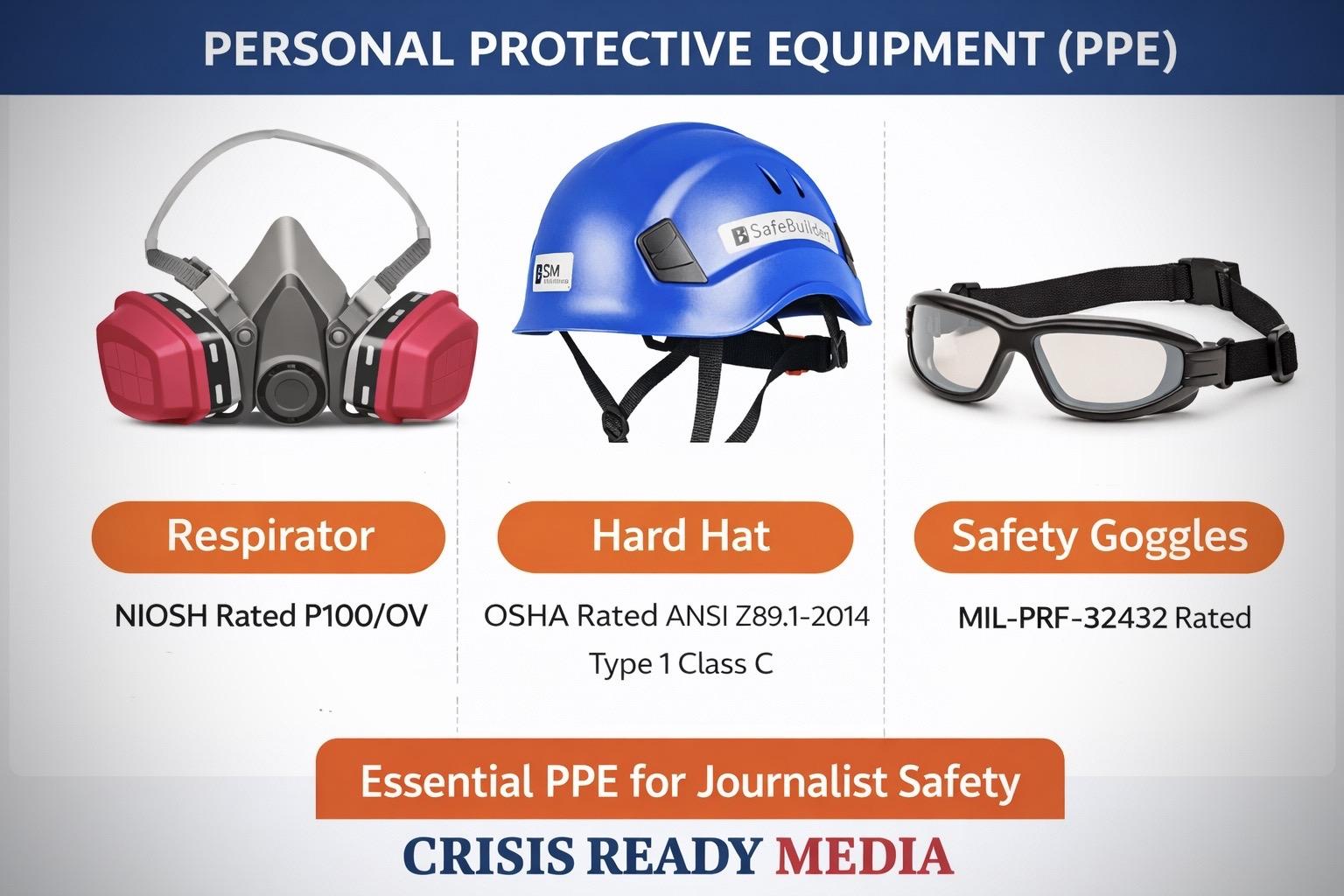
Eye injuries represent some of the most severe and permanent outcomes documented in protest coverage. At minimum, journalists should wear impact-rated eyewear meeting MIL-PRF-31013 or standards. Look for the MIL-PRFmarking, which indicates high-velocity impact (640-660FPS) certification. The olde, Basic Z87 provides only basic impact protection and will not counter current threats.
Recommended specifications:
• MIL-PRF-31013 rated (high-velocity impact)
• Full-seal or goggle-style for chemical agent environments
• Anti-fog coating (X marking indicates anti-fog compliance)
• Avoid contact lenses in chemical agent environments
CPJ guidance specifically notes that contact lenses should not be worn when tear gas deployment is possible, as the gas can become trapped under lenses and cause corneal damage.
Respiratory Protection
Tear gas (CS, CN) and pepper spray (OC) are commonly deployed during civil unrest. The CDC NIOSH Pocket Guide specifies that protection against alpha-chloroacetophenone (CN/Mace) and 2-chlorobenzalmalononitrile (CS gas) requires an organic vapor cartridgecombined with P100 particulate filtration.
Minimum standard:
• NIOSH-approved half-face or full-face respirator
• OV/P100 combination cartridges (e.g., 3M 60921, 60926)
• Proper fit-testing for reliable seal
• Spare cartridges (exposure to moisture reduces effectiveness)
Note: Individuals with asthma or respiratory conditions should avoid areas where tear gas may be deployed.
Head Protection
Helmet selection depends on threat assessment. For most domestic civil unrest coverage, a bump helmet provides adequate protection against thrown objects, falls, and incidental impacts while remaining lightweight and comfortable for extended wear.
Type
Use Case
Standards
Bump helmet
Domestic protests, debris, falls, blunt impacts. Lighter weight (400-800g)
EN 1385, EN 12492, or ACH blunt impact specs
Ballistic helmet
Active shooter risk, armed conflict coverage. Heavier (1.2-1.5kg)
NIJ 0106.01 Level IIIA
CPJ recommends that journalists covering conflict zones or situations where live ammunition is possible use Level IIIA ballistic protection. For typical domestic protest coverage without active shooter indicators, bump helmets offer practical protection with better comfort and visibility.
Body Protection
Body armor selection follows the NIJ protection level system. As of April 2024, NIJ Standard 0101.07 and 0123.00 define current ballistic protection levels. The new nomenclature uses HG (handgun) and RF (rifle) designations, though Level IIIA remains the common reference for soft armor protecting against handgun threats.
NIJ Level
Protection
Journalism Use Case
IIA / II
9mm, .40 S&W at standard velocities
Light, concealable; lower threat environments
IIIA
.357 SIG, .44 Magnum; most handgun threats
Recommended minimum for high-risk assignments
III / IV
Rifle rounds; Level IV stops armor-piercing
Conflict zones, active combat coverage
For civil unrest coverage where live ammunition is not anticipated, a stab-resistant vest or Level IIA/II soft armor provides meaningful protection against blunt impacts, thrown objects, and edged weapons while remaining relatively lightweight.
Equipment and Training Notes
Clothing considerations
• Avoid loose-fitting clothing that can be grabbed
• Avoid flammable synthetic materials (nylon) in favor of cotton or wool
• Do not wear military fatigues or all-black attire
• Clearly mark helmet and clothing with PRESS identification
• Wear sturdy, closed-toe footwear with ankle support
Training requirements
The ACOS Alliance Industry Standard for Safety Training (ISST) recommends that journalists covering civil unrest complete hostile environment awareness training (HEFAT) covering situational awareness, first aid, and de-escalation techniques. Key competencies include:
• Proper PPE donning, doffing, and inspection
• Respirator fit-testing and seal checks
• Recognizing escalation indicators and extraction timing
• Basic trauma first aid and IFAK usage
• Chemical agent decontamination procedures
Border and travel considerations
PPE regulations vary by jurisdiction. Ballistic vests and helmets may be classified as controlled items in some countries. CPJ advises researching country-specific regulations before traveling internationally with PPE. Within the U.S., body armor purchase and possession is legal in most states, though some restrict sales to convicted felons.
Legal and Ethical Considerations
Journalists should understand their legal rights before covering protests. The Reporters Committee for Freedom of the Press maintains a legal hotline (1-800-336-4243) and publishes guidance on journalists' rights during protest coverage. Key points:
• Press credentials do not provide immunity from lawful orders to disperse
• Journalists have the right to photograph or record in public spaces
• Equipment seizure without warrant may be legally challengeable
• Document any incidents of interference with press activities
Consult a qualified attorney for specific legal questions. This report provides general information and does not constitute legal advice.
Mental Wellness and Peer Support
Covering civil unrest can involve exposure to violence, trauma, and sustained stress. The Dart Center for Journalism and Trauma recommends that journalists and editors:
• Conduct pre-assignment briefings addressing psychological preparation
• Establish buddy systems and regular check-ins during assignments
• Schedule post-assignment debriefs to process experiences
• Provide access to trauma-informed counseling resources
Journalists experiencing persistent symptoms of stress, anxiety, or trauma-related distress should seek support from a mental health professional. CPJ and the Dart Center maintain referral resources for journalists.
Implementation Checklist
Use this checklist before civil unrest assignments. Print and complete with your editor or safety manager.
Pre-Assignment Preparation
☐ Complete risk assessment for specific location and event
☐ Review local laws on press access and PPE restrictions
☐ Confirm insurance coverage (medical, evacuation, equipment)
☐ Establish check-in schedule with editor or safety contact
☐ Identify medical facilities and evacuation routes
PPE and Equipment Checks
☐ Eye protection: MIL-PRF-31013 rated, clean, undamaged
☐ Respirator: Fit-tested, OV/P100 cartridgescurrent, spare cartridges packed
☐ Helmet: ANSI 87.1 Type II (Top and side impact rated) This helmet does not offer ballistic protection. Inspected for cracks or damage, straps functional
☐ Body armor (if required): NIJ IIIA certification current, proper fit confirmed
☐ PRESS markings visible on helmet and outer clothing
☐ IFAK (individual first aid kit) stocked and accessible
Digital Security Setup
☐ Phone charged with portable backup power
☐ Encrypted communications app configured
☐ Consider burner phone if metadata is a concern
Field Movement and Comms Plan
☐ Primary and alternate meeting points identified
☐ Escape routes mapped from likely positions
☐ Vehicle parked in secure location facing exit direction
☐ Buddy/backwatcher assigned if working in team
After-Action Review Prompts
☐ What worked well with PPE and positioning?
☐ What escalation indicators did we observe?
☐ Were there near-misses or equipment failures?
☐ How is the team's psychological state?
☐ What should we change for next assignment?
Limitations and Assumptions
This report assumes:
• Coverage occurs in the United States or jurisdictions with similar PPE availability
• Journalists have budget access for quality PPE (see resource section for loan programs)
• Users will verify current standards and regulations before purchase
• PPE is one component of safety; situational awareness and sound judgment remain essential
Limitations:
• Standards and regulations change; verify current versions before relying on specific certifications
• Individual medical conditions may affect PPE suitability (consult healthcare provider)
• No PPE provides absolute protection; risk reduction is the goal, not elimination
References and Further Reading
Standards and Specifications
1. ANSI/ISEA Z87.1-2020, American National Standard for Occupational and Educational Personal Eye and Face Protection Devices. Available: webstore.ansi.org
2. NIJ Standard 0101.07, Ballistic Resistance of Body Armor (November 2023). Available: nij.ojp.gov
3. NIJ Standard 0123.00, Specification for NIJ Ballistic Protection Levels and Associated Test Threats (November 2023). Available: nij.ojp.gov
4. CDC NIOSH Pocket Guide to Chemical Hazards: alpha-Chloroacetophenone. Available: cdc.gov/niosh/npg
Journalist Safety Resources
5. Committee to Protect Journalists, Physical Safety: Civil Disorder (updated March 2024). Available: cpj.org
6. CPJ, A Guide to Personal Protective Equipment (PPE). Available: cpj.org/emergency-response
7. ACOS Alliance, Freelance Journalist Safety Principles. Available: acosalliance.org/the-principles
8. ACOS Alliance, Civil Unrest Safety Resources. Available: acosalliance.org/civil-unrest
9. Reporters Committee for Freedom of the Press, Covering Protests. Available: rcfp.org
Data Sources
10. U.S. Press Freedom Tracker, Assault Database. Available: pressfreedomtracker.us
11. CPJ, "On Edge: What the US Election Could Mean for Journalists and Global Press Freedom" (October 2024). Available: cpj.org
About Crisis Ready Media
Crisis Ready Media produces evidence-based safety resources for journalists and newsrooms. For questions, corrections, or training inquiries, contact us at info@crisisreadymedia.org